


Driving in France: Rules, Habits, and Cultural Surprises
Driving in France isn’t just about following traffic laws. It’s also about understanding local driving habits, cultural differences, and a few rules that might surprise you if you’re from another country. In this episode, I break it all down with simple explanations and personal anecdotes to help you feel more confident on the road in France.
TRAVEL
Estelle Materne - de Parlons French
2/14/20263 min read
Driving in France: Rules, Habits, and Cultural Surprises
Driving in France isn’t just about following traffic laws.
It’s also about understanding a certain driving style, local habits, and rules that can be surprising if you’re coming from another country.
In this podcast episode, I talk about all of this through simple explanations and personal anecdotes.
Why read before listening?
This article helps you:
Identify key vocabulary
Understand the main rules
Become familiar with the context
You can first read it in English, and then in French !
When you listen to the episode, you’ll recognize the words and ideas more easily.
Enjoy reading… and enjoy listening!
1 – The Points-Based License: A Very French Source of Pride
In France, driver’s licenses operate on a points system.
When you first get your license, you’re given a certain number of points. If you commit a traffic violation (speeding, using your phone while driving, running a red light, etc.), you lose points.
If you lose all your points, you can lose your license. Many French people (myself included!) proudly say: “I still have all my points!” That means they haven’t committed any serious violations.
2 – Right-of-Way to the Right: A Surprising Rule
Right-of-way to the right is a very important rule in France.
It means that at certain intersections without signs or signals, you must yield to vehicles coming from your right.
In some countries, this rule is rare or doesn’t exist. In France, it still does — and it’s sometimes intentionally used in small towns to slow down traffic. So you need to stay very alert, especially in residential areas.
3 – Roundabouts: Everywhere (and Sometimes Stressful)
France is one of the countries with the highest number of roundabouts. The main rule:
Vehicles already inside the roundabout have the right of way (with the exception of some very important roundabouts, like the one around l'Arc de Triomphe)
A few important tips:
Position yourself correctly depending on your exit
Use your turn signal
Check your blind spots before exiting
Roundabouts help traffic flow smoothly, but they can feel intimidating at first.
4 – Red Lights and Pedestrians
In France, you cannot turn right on a red light unless there is a specific orange arrow allowing it.
Pedestrians have the right of way when crossing at a marked crosswalk.
It is mandatory to stop for them. This is something that is often strictly enforced.
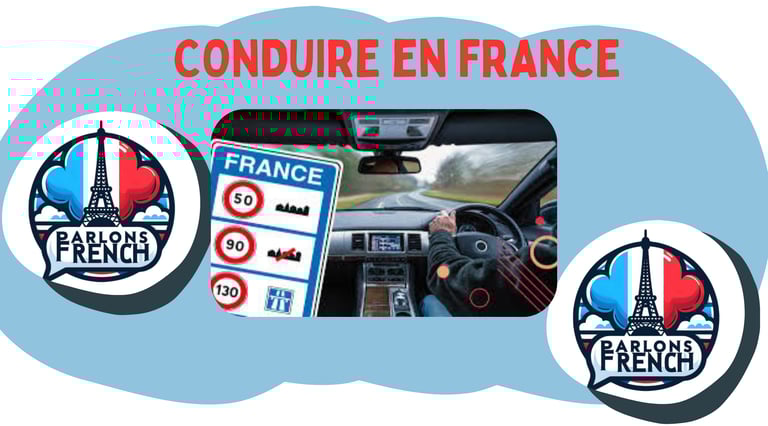
5 – Speed Limits and Speed Cameras
Speed limits vary depending on the type of road:
In cities: usually 50 km/h (sometimes 30 km/h)
On regular roads: often 80 km/h
On highways: 130 km/h (110 km/h when it’s raining)
France is known for its many automatic speed cameras.
If you exceed the speed limit, you may receive a ticket by mail.
You’ll sometimes hear people say:
“I got flashed.” That means a speed camera took a picture of their car.
6 – Toll Highways
In France, many highways are toll roads.
You take a ticket when you enter, and you pay at the toll booth when you exit. The amount depends on the distance traveled. For people used to free highways, this can be surprising.
7 – Parking in the City
Parking in French city centers can be complicated.
Spaces are often small
Parking is usually paid
Historic city centers can be difficult to access
You often need to use underground parking garages or parking apps.
8 – A Cultural Matter
Beyond the rules, driving in France is also about understanding a culture:
A certain impatience in large cities
Faster driving on secondary roads
Strong attention to rules… especially because of speed cameras
Driving in France requires observation, anticipation, and adaptation.
Enjoy driving… and enjoy listening 🚗🇫🇷
written by Estelle Materne
Estelle has been a language teacher for the past 15+ years, she specializes in elevating intermediate learners to a close to native way of using French.
She's lived and taught in many countries around the globe, including China and the US , and she's now back to her home country, France; in the beautiful town of Besançon, from where she keeps teaching her beloved language online !


Follow Me



Learn French with clarity, confidence, and real human guidance
Content :
Podcast (Authentic French)
Blog (Authentic ressources)
Interactive Map (Authentic French speakers)